
Sphere Launches Regulated Operations in Mexico for US-Mexico Cross-Border Payments
MXN <> USD payments for importers, exporters, and fintechs, designed for same-day settlement, now in private beta ahead of a September launch
Sphere is putting down roots in Mexico with an in-country team and regulated local operations, moving money between pesos and dollars through a money transmitter registered with the Comisión Nacional Bancaria y de Valores (CNBV) for the businesses trading across the US-Mexico border.
The Scale of the US-Mexico Payments Corridor
Mexico has been the largest goods-trade partner of the United States for three years running, with an estimated $871.6 billion in goods trade in 2025, more than $2.3 billion crosses the border every day. The flows keep deepening as manufacturing moves closer to home and foreign direct investment into Mexico reaches new records, a fifth straight year of growth at $40.9 billion.
Behind every trailer that clears the border there is a payment that has to be cleared alongside it, an invoice to reconcile, and a supplier or importer waiting on money that still travels far more slowly than the freight does. Pesos already move in seconds inside Mexico on SPEI, the country's real-time interbank system. Turning those pesos into dollars across the border has remained slow and costly, running through correspondent banking chains that can take several days and add cost at every hop. The network underneath has also been shrinking, with active correspondent relationships in Latin America falling 47% between 2011 and 2022, the steepest decline of any region. Sphere is building infrastructure on the ground and inside the regulated system, so that moving between pesos and dollars gets faster and more dependable for businesses on both sides of the border.
Compliance as the Foundation
Sphere enters every market through the front door, compliance first, because the groundwork decides how much can be built later. No market proves the point like Mexico.
As global banks pulled back from clearing dollars for Mexican institutions over the last decade, the Bank of Mexico built its own domestic dollar clearing system in 2016 to reduce reliance on US correspondent banks, and the durable lesson from that period is that dollar access in Mexico turns on trust and compliance. Sphere built its controls and its local team around that lesson, and its Mexican operations run through Titan Transfer México, S.A. de C.V., registered as a transmisor de dinero with the Comisión Nacional Bancaria y de Valores, so the peso leg is handled in-country under that entity's own authorization. Stitching that capability together from some combination of brokers, local partners, and informal market makers is the more common path, and it tends to be fragile in exactly the moments that matter. The team is in Mexico and the registration is Mexican, a lasting presence built to operate in the market and support the businesses that depend on it.
"Mexico is a key geopolitical anchor for the entire American trade corridor, and the opportunity is evident in the level of latent demand from real businesses that the traditional system has never prioritized. This makes it one of the best opportunities and setups in payments anywhere right now," said Arnold Lee, CEO and co-founder of Sphere. "We built for that the right way, with a local team on the ground and a registered local operation, because that is what it takes to serve this market well, and we intend to be part of how money moves through this region for a long time."
Working Alongside SVA Law
Sphere is building in Mexico with the support of SVA Law, the Mexico City firm also known as Singularity Venture Advisors, whose practice is built around the exact work this market demands: fintech licensing, anti-money-laundering program design, and the cross-border structuring that maps what a US institution expects onto what a Mexican regulator and a Mexican bank need to see before anything clears.
Its founding partner, Héctor Camacho, advised the Bank of Mexico before turning to fintech, and its of counsel, Juan Pablo Graf Noriega, served as president of the CNBV, Mexico's banking and securities regulator. The firm works from the conviction that regulation, handled early and with care, becomes an advantage in its own right, which is the same view that shaped how Sphere entered the market.
"Mexico's financial system rewards companies that engage with the rules early and build their licensing and compliance foundations from the start," said Juan Pablo Graf Noriega, Of Counsel at SVA Law and former president of the CNBV.
MXN <> USD Payments for Importers, Exporters, and Fintechs
Access in this first phase is API-first, with settlement between pesos and dollars designed for same-day (“T+0”), built to reduce the losses and volatility that businesses across the corridor absorb today. Businesses moving money across this border measure a payment by when it lands, what it costs, and whether it gets them the dollars they need. Sphere's work is to keep improving all three, with onboarding that is straightforward without loosening compliance, and speed at every step, since time in transit is exposure to the exchange rate.
Sphere is building for the fintechs and platforms that serve the businesses moving goods across this border, embedding cross-border payments within the products those businesses already use. The companies they serve span the corridor, importers and exporters ranging from automotive supply chains to manufacturers moving inputs north and south, along with the multinationals that sweep funds from their Mexican subsidiaries into their US entities. The machinery that produces all of this stays out of sight, so that using the corridor gets simpler even as what runs underneath it gets more sophisticated.
A Long-Term Commitment to the Americas Corridor
Sphere started in the Americas because the corridor between the US and Latin America is where the distance between how much commerce moves and how well the money layer serves it is the widest, and the company has treated Mexico as the center of that plan from the beginning. The launch into Mexico is one piece of a longer build toward connecting the region over time, with more to come as it is ready. Sphere has spent years building on both sides of this corridor, in licensing, banking relationships, and local teams, and operating both ends of a payment itself is the point of the design. Money that moves through infrastructure one company has built end to end clears more predictably, and when something breaks, one team fixes it. Businesses that experience that tend to stay. Getting licensed and building locally is slow work, and it is the approach Sphere believes lasts, which is why the company chose to start on the ground, with the regulated operations in place.
Talk to Our Team
MXN <> USD rail support is in private beta with a select group of integrators ahead of a September launch. Fintechs and platforms that want an API-first way to move between pesos and dollars can reach Sphere's sales team about integration. Importers, exporters, and multinationals operating across the corridor can get in touch as well, and Sphere will connect them with the right path, including through its partner integrators.
Payment services in Mexico are provided by Titan Transfer México, S.A. de C.V., registered as a transmisor de dinero with the Comisión Nacional Bancaria y de Valores (registration folio 22531).

Subscribe to Sphere Blog
No spam. Just the latest releases and tips, interesting articles, and exclusive interviews in your inbox every week.

Supporting EEA Customers: Enhanced Verification For Individuals
Sphere now supports enhanced verification for individual customers in the EEA+ region, in line with MiCA.
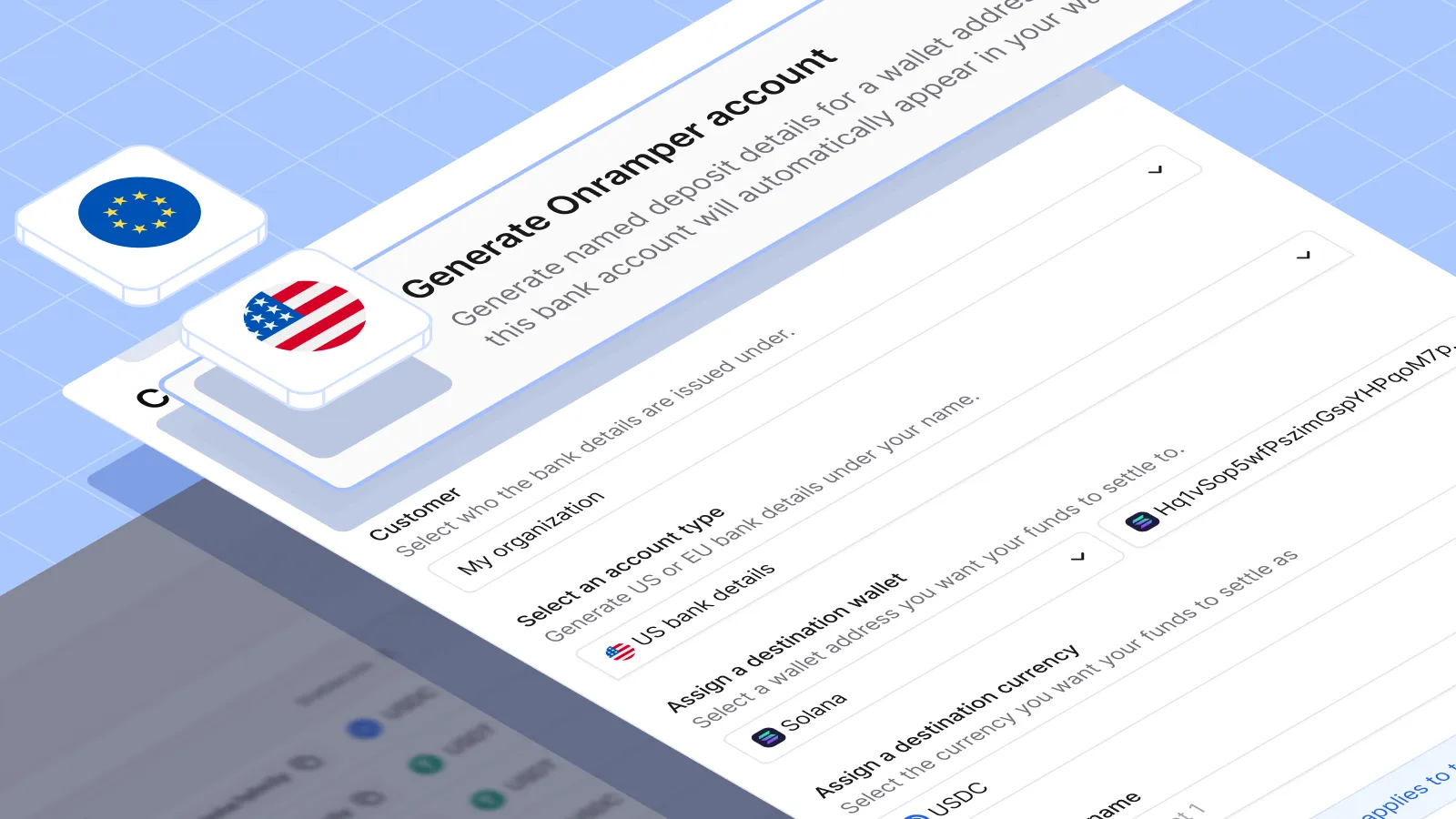
Onramper Accounts: Automated Fiat-to-Stablecoin Conversion, Now on the Dashboard
Generate dedicated zero balance, static routing accounts